Study abroad insights
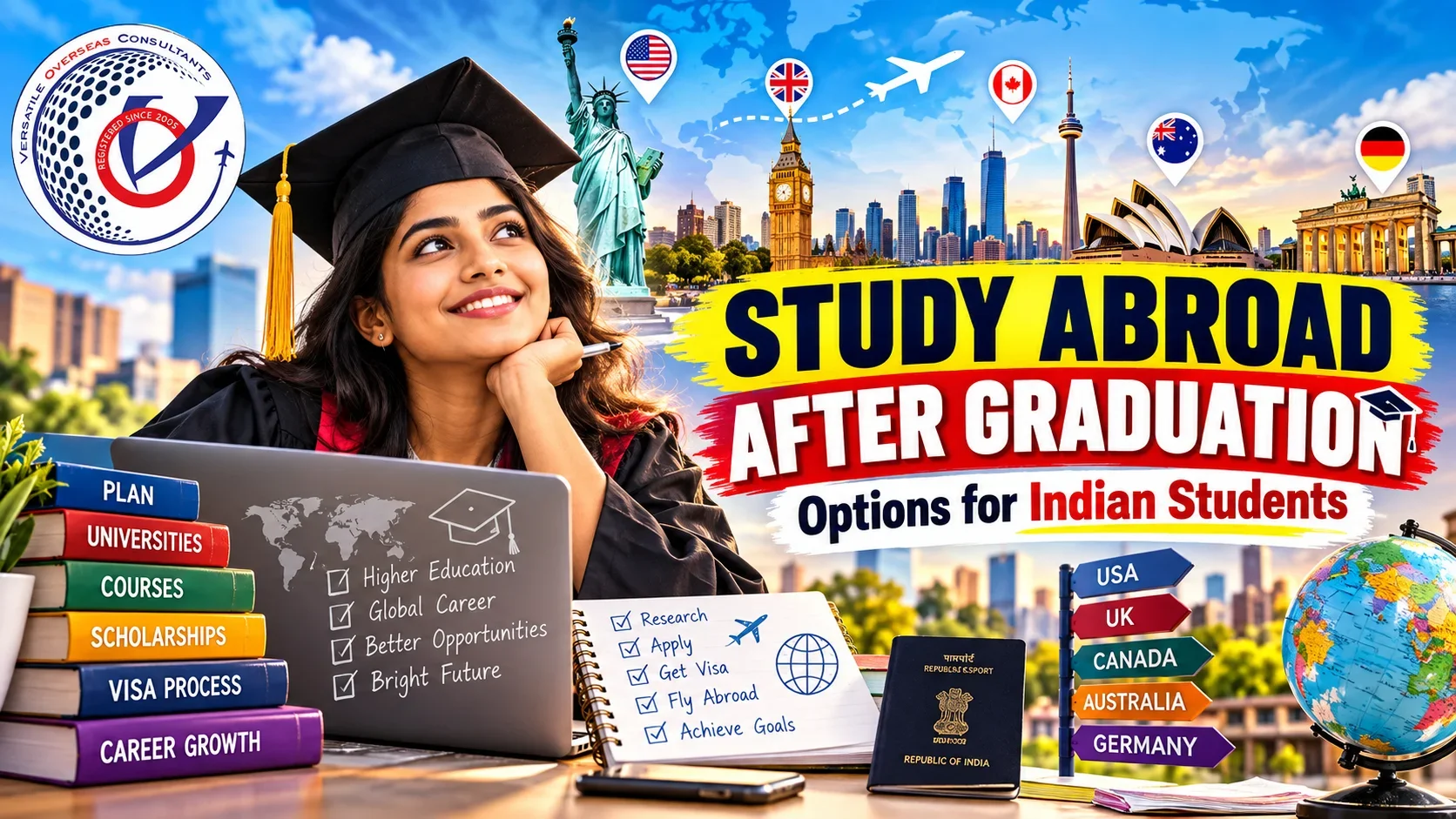
Study Abroad After Graduation: Options for Indian Students
A guide for Indian graduates choosing master’s, postgraduate and career-focused programmes abroad, with eligibility, tests, work experience, costs and application planning.
A guide for Indian graduates choosing master’s, postgraduate and career-focused programmes abroad, with eligibility, tests, work experience, costs and application planning.
By Rashmi Matlani
October 2, 2026
Quick answer
After graduation in India, students can apply for master’s degrees, specialist postgraduate programmes, conversion courses, research degrees and selected professional programmes abroad. The right option depends on your bachelor’s degree, prerequisites, academic record, work experience, career goal and budget.
Do not choose a master’s merely because it appears employable. The programme should make sense as the next step in your academic or professional story.
Popular routes after graduation
Master’s in the same field
Examples:
BTech Mechanical → MSc Mechanical/Automotive/Manufacturing
BSc Biotechnology → MSc Biotechnology/Bioinformatics
BCom → MSc Finance/Accounting
BCA/BTech → MSc Computer Science/Data Science
This is usually the simplest academic progression.
Specialisation
You remain in the same broad field but move into a niche:
engineering → renewable energy
computer science → cybersecurity
business → supply chain
statistics → data analytics
Interdisciplinary master’s
Some programmes intentionally combine fields, such as:
engineering management
business analytics
health informatics
financial technology
human-computer interaction
Career conversion
Some universities offer programmes designed for students from other academic backgrounds. Entry requirements vary, so verify whether prior coursework is required.
Can you change your field?
Yes, in some programmes. But the larger the change, the more important it is to show evidence of preparation.
For example, a student moving into data science may need mathematics, statistics or programming prerequisites. A strong SOP cannot replace mandatory prerequisite subjects.
Is work experience required?
Not for every master’s programme.
Many MSc and MA programmes accept fresh graduates. MBA and executive-style programmes often expect professional experience, although requirements vary.
Check whether experience is:
- mandatory
- recommended
- used competitively
- irrelevant to admission
Do you need GRE or GMAT?
Only if the programme or university requires or values it. Policies differ by institution and can change.
Build the university shortlist before deciding whether to take these tests.
English-language requirements
IELTS, TOEFL and PTE are widely used, but acceptance and minimum scores vary by university and course. Some universities may waive a test based on previous education, subject to their policy.
One-year vs two-year master’s
A one-year master’s can reduce time and living costs. The UK offers many one-year postgraduate programmes.
A two-year programme can offer more time for coursework, research, internships or specialisation depending on the system.
Compare:
- curriculum depth
- research component
- internship
- total cost
- career relevance
How to shortlist programmes
For every programme, record:
- entry requirements
- prerequisite subjects
- tuition
- duration
- curriculum
- optional modules
- project/dissertation
- accreditation
- location
- scholarship
- graduate support
Avoid selecting programmes only because the title contains “AI,” “data,” “management” or another trending term.
Application documents
Common requirements include:
- bachelor’s transcripts
- degree/provisional certificate
- CV
- SOP/personal statement
- recommendations
- English test
- portfolio for relevant programmes
- work-experience evidence if required
How early should you begin?
A 12–18 month planning horizon is sensible for competitive destinations and scholarships. EducationUSA recommends early research because institutional deadlines and aid deadlines can differ.
Common mistakes after graduation
- choosing a programme unrelated to long-term goals
- ignoring prerequisites
- relying only on rankings
- taking unnecessary tests before shortlisting
- failing to explain academic gaps or career transitions
- comparing annual tuition rather than total cost
- assuming work experience compensates for missing academic prerequisites
Frequently asked questions
Can I study abroad immediately after graduation?
Yes. Many postgraduate programmes accept fresh graduates.
Is a three-year Indian bachelor’s accepted?
It depends on the country, university and programme. Verify the institution’s policy for your exact Indian qualification.
Can I apply in my final year?
Often yes, using available transcripts, with the final degree/result submitted later as a condition.
Is an MBA the best option after any bachelor’s degree?
No. MBA suitability depends on career goals and often on work experience. MSc, MA and specialist programmes may be more appropriate.
Masters abroad for Indian students: build the search around career fit
Common postgraduate searches include “masters abroad for Indian students,” “MS abroad,” “MBA abroad,” “best countries for masters,” “study abroad after graduation,” “masters abroad without GRE,” “masters abroad without IELTS” and “scholarships for masters abroad.” These phrases reflect different parts of the same decision.
For a strong postgraduate shortlist, compare the exact master’s curriculum, prerequisites, work-experience requirement, tuition fees, scholarship options, course duration, internship or research component and student-visa conditions. Students should also check whether a programme is a natural academic progression, a specialisation or a genuine conversion course. This is particularly important for Indian graduates moving from engineering, commerce, science or computer applications into fields such as data science, business analytics, finance, cybersecurity or management.
Related reading
These guides on the Versatile Overseas Consultants blog cover closely connected questions:
- Best Countries for Indian Students to Study Master's Abroad
- How to Study Abroad from India: Complete Step-by-Step Guide
- How Much Does It Cost to Study Abroad from India?
- Which Country Is Best for Indian Students to Study Abroad?
How Versatile Overseas Consultants can help
Versatile Overseas Consultants is a study abroad consultancy established in 2005, with offices in Nashik and Pune. After the 30-minute call, the team can support you with study abroad counselling, university shortlisting and SOP and LOR guidance, depending on where you are in your plan. You can also read more about Versatile Overseas Consultants or explore universities abroad for Indian students.
Book a 30-minute Study Abroad Clarity Call
Not sure how this applies to your own profile, budget and target intake? Get your master's plan checked against your academic background in a one-to-one session. Book your 30-minute Study Abroad Clarity Call with Versatile Overseas Consultants and leave with a clear next step, before you apply anywhere.
Sources and further reading
← Back to all articles
Trusted study abroad guidance for ambitious students and parents planning overseas education with transparency. Established in 2005.
Contact Offices
Nashik HQ: 401, Dattatray Darshan, College Road
Pune Hub: Shop 104, 10 Biz Park, Viman Nagar
© 2026 Versatile Overseas Consultants. All Rights Reserved.