
Quick answer
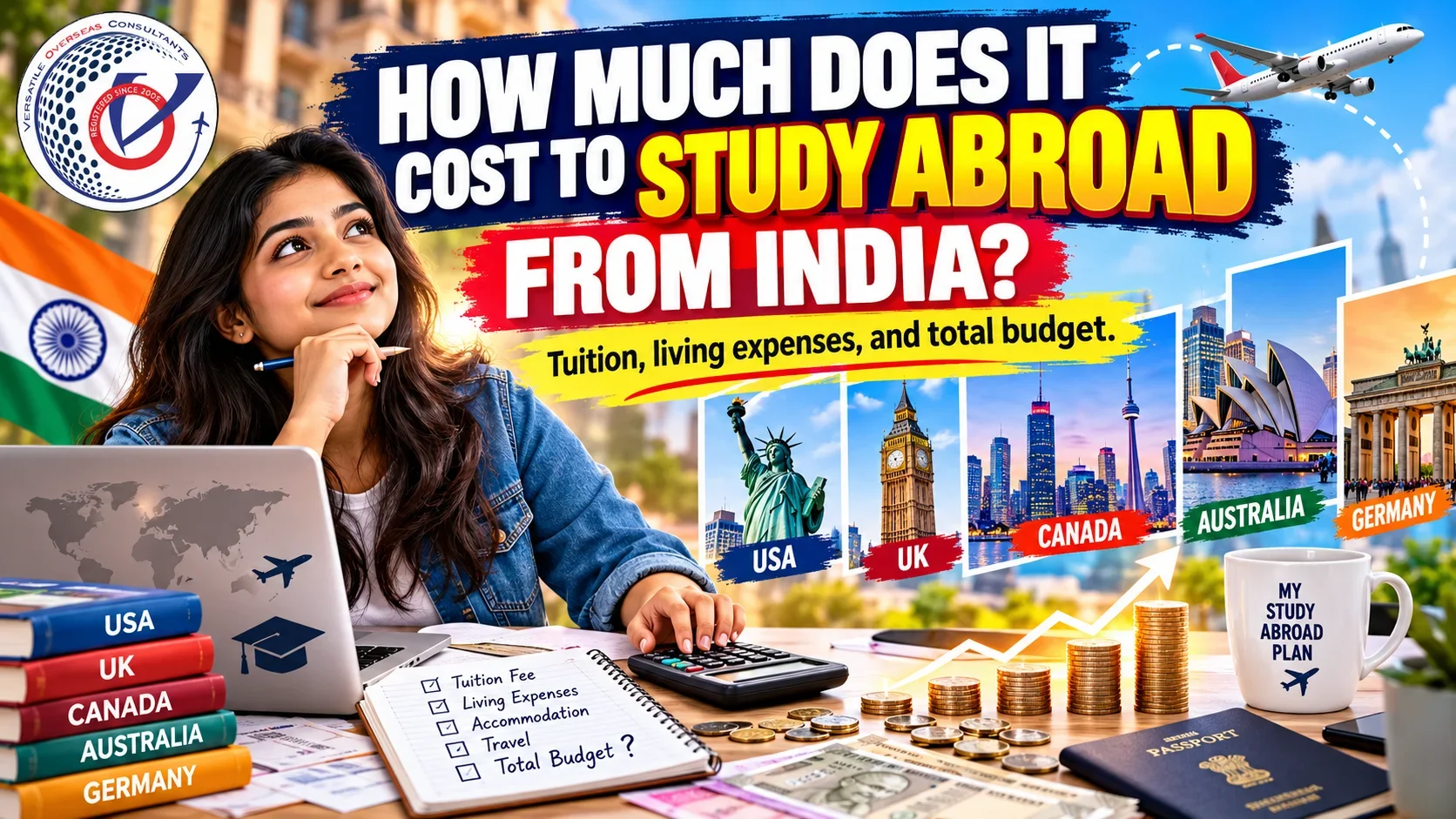
The total cost of studying abroad is not just tuition. Indian families should budget for tuition, living expenses, insurance, visa charges, deposits, testing, application fees, travel, books/equipment and an emergency buffer.
Because exchange rates move and university fees differ, use foreign-currency figures from official sources and convert them to rupees at the time of planning.
The seven major cost heads
1. Tuition fees
Tuition depends on country, university, level and subject. Clinical, laboratory, engineering, business and specialist programmes may cost more than classroom-based programmes.
For the UK, Study UK currently gives broad international-student tuition ranges of £11,400–£38,000 for undergraduate study and £9,000–£30,000 for postgraduate study.
In Germany, DAAD states that there are generally no tuition fees for bachelor’s and most master’s courses at state higher-education institutions, but important exceptions exist.
2. Living expenses
Living costs can change dramatically by city.
UK guidance from Study UK suggests budgeting approximately £1,300–£1,400 per month in London and £900–£1,300 per month elsewhere for accommodation, bills, groceries and other living expenses.
DAAD estimates roughly €900–€1,200 per month in Germany depending on location.
Australia’s official Study Australia portal recommends using its Cost of Living Calculator because expenses vary by accommodation, transport and lifestyle.
3. Student visa and immigration costs
Visa fees change periodically. Always use the official immigration website on the date of application.
For example, Australia increased the primary Student visa application charge to AUD 2,500 from 1 July 2026 for most applicants.
Visa-related expenses may also include:
- biometrics
- health checks
- TB tests
- police certificates where required
- document translation
- courier charges
4. Health insurance
Some destinations or institutions require specific health cover. Do not assume Indian health insurance will satisfy student-visa requirements overseas.
5. Tests and applications
Possible costs include:
- IELTS/PTE/TOEFL
- GRE/GMAT where needed
- university application fees
- score reporting
- transcript preparation
- credential evaluation
6. Travel and initial setup
Budget for:
- flight tickets
- baggage
- airport transfer
- temporary accommodation
- rental deposit
- bedding and basic household items
- SIM card
- transport pass
- winter clothing if needed
The first month can be more expensive than an average month because of deposits and setup costs.
7. Emergency buffer
A budget with zero margin is risky. Keep a contingency for exchange-rate movement, medical expenses, unexpected travel or delayed part-time income.
Why course duration changes the total cost
A two-year degree can involve two years of living expenses even if annual tuition is moderate.
A one-year programme may have higher annual tuition but lower total accommodation and living cost. Compare total programme cost, not only “fees per year.”
How Indian families should create a study-abroad budget
Use this formula:
Total budget =
tuition for full course
- estimated living expenses
- visa and insurance
- tests and application charges
- travel and initial setup
- contingency buffer
− confirmed scholarships
Do not subtract expected part-time earnings unless they are actually guaranteed. Part-time work can support expenses but should not be the foundation of the funding plan.
Visa financial evidence is different from actual cost
A country’s minimum visa financial requirement is not necessarily the amount you will actually spend.
For the UK, the Student route currently requires evidence for outstanding course fees plus specified monthly maintenance amounts. The official guidance lists £1,529 per month in London and £1,171 outside London, up to nine months. Actual living expenses may be higher.
How to reduce study-abroad costs
- compare total cost across cities, not only countries
- apply early for scholarships
- consider universities outside the most expensive cities
- compare one-year and two-year programmes
- look at public universities where appropriate
- use student accommodation and transport options carefully
- avoid overpaying through poor forex planning
- keep an emergency fund separate
Frequently asked questions
Can I study abroad under ₹15 lakh?
In some destinations and programmes it may be possible, especially where tuition is low, but ₹15 lakh may not cover every cost. It depends on course duration, city, exchange rate and scholarship.
Is Germany always the cheapest?
No. Tuition can be low at many public institutions, but living expenses, semester contributions, insurance and proof of funds remain significant.
Should I use today’s exchange rate?
Use a conservative planning rate rather than assuming the most favourable rate will continue.
How much extra should I keep?
There is no universal figure, but a contingency buffer should be part of the plan.
Study-abroad fees, living costs and return on investment
For Indian families, the real cost of studying abroad should include foreign university tuition fees, accommodation, food, health insurance, student-visa charges, travel, application fees, English-language tests, deposits and emergency funds. This is why searches such as “study abroad cost for Indian students,” “cost of masters abroad,” “living expenses for international students” and “education loan for study abroad” should be evaluated together.
Return on investment should also be considered cautiously. A lower-cost university is not automatically better, and a high-cost destination is not automatically better for jobs. Compare the total amount invested with course quality, duration, curriculum, accreditation, career services and realistic employment options. Post-study work rights and salary expectations can change, so use current government and labour-market information rather than promotional claims.
Related reading
These guides on the Versatile Overseas Consultants blog cover closely connected questions:
- Study Abroad Under ₹20 Lakhs: Complete Guide
- Study Abroad Under ₹15 Lakhs: Countries and Universities to Consider
- Cheapest Countries to Study Abroad for Indian Students
- Best Countries to Study Abroad on a Budget
How Versatile Overseas Consultants can help
Versatile Overseas Consultants is a study abroad consultancy established in 2005, with offices in Nashik and Pune. After the 30-minute call, the team can support you with education loan assistance, scholarship guidance and study abroad counselling, depending on where you are in your plan. You can also read more about Versatile Overseas Consultants or explore universities abroad for Indian students.
Book a 30-minute call
Not sure how this applies to your own profile, budget and target intake? Get your budget and funding plan checked against your academic background in a one-to-one session. Book a 30-minute call with Versatile Overseas Consultants and leave with a clear next step, before you apply anywhere.