Study abroad insights
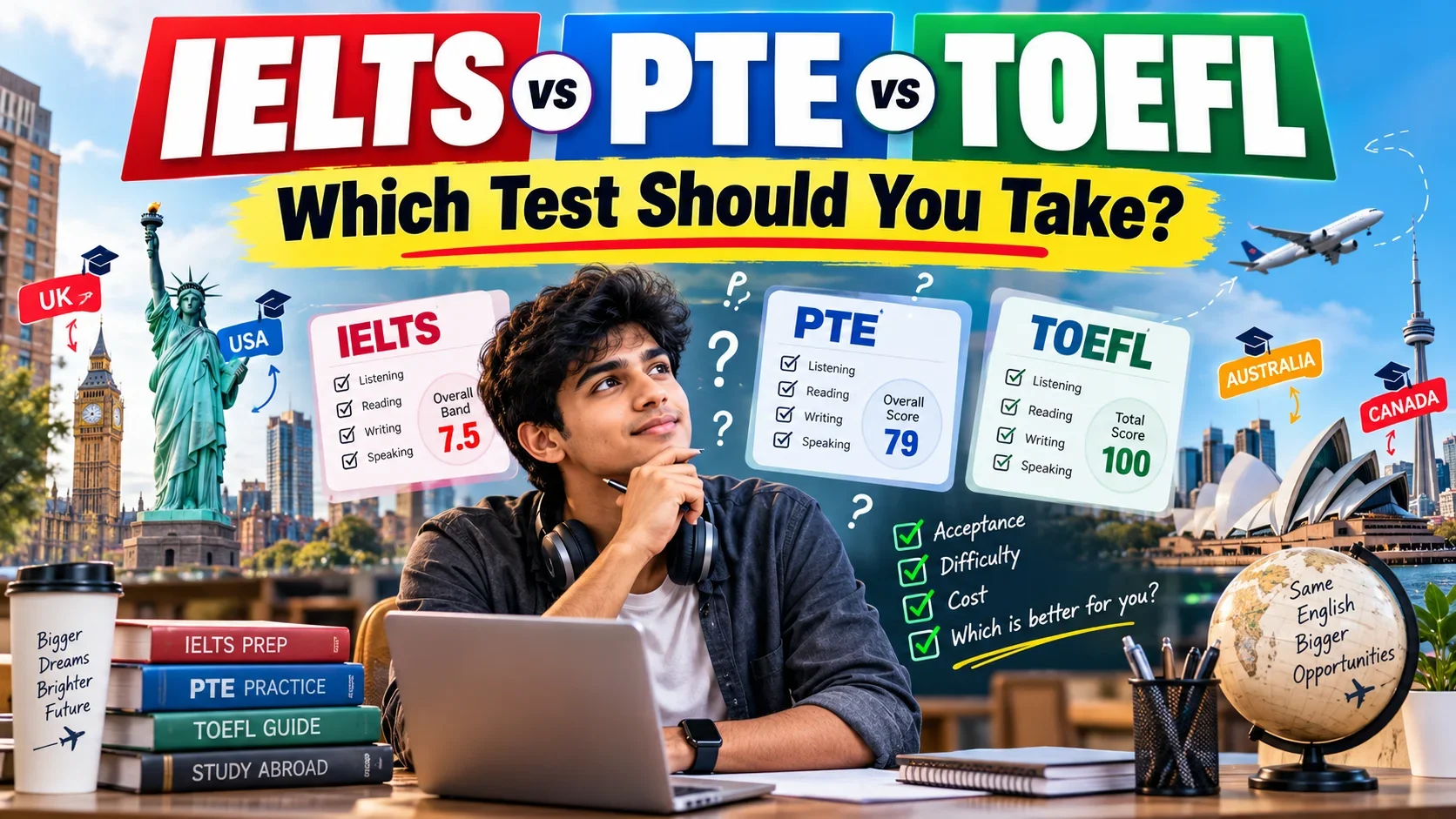
IELTS vs PTE vs TOEFL: Which Test Should You Take?
A practical comparison of IELTS, PTE Academic and TOEFL iBT for Indian students choosing an English-language test for overseas study.
A practical comparison of IELTS, PTE Academic and TOEFL iBT for Indian students choosing an English-language test for overseas study.
By Parth Mehra
October 2, 2026
Quick answer
There is no universally best English test. Choose the exam accepted by all your target universities and visa route, then consider test format, availability, scoring style and your personal strengths.
A practical rule:
- shortlist universities first
- list the tests each accepts
- check visa requirements
- take the test that keeps the widest set of your options open
TOEFL iBT
TOEFL is an academic English test commonly used for university admissions.
ETS states that TOEFL iBT is accepted by more than 13,000 institutions in 160+ countries.
Consider TOEFL if:
- all your target universities accept it
- you are comfortable with an academic computer-based environment
- you want broad global university acceptance
ETS advises students to verify individual institutional requirements because minimum scores are set by the institution.
PTE Academic
PTE Academic is a computer-based test assessing speaking, writing, reading and listening.
Pearson states:
- the test takes about two hours
- results are typically available in about two days
- it is accepted by 4,000+ universities and colleges worldwide
Consider PTE if:
- you prefer a fully computer-based test experience
- fast result turnaround is important
- your target universities and visa route accept it
IELTS
IELTS Academic is one of the best-known English tests for international education and is accepted by institutions across major study destinations.
Students should choose the appropriate IELTS test type required by the institution or visa route and verify whether computer-delivered or paper-based options are available locally.
Which one is easier?
“Easier” is subjective.
A student comfortable speaking into a microphone may prefer one format. Another student may perform better in a different speaking environment.
Before deciding:
- take official sample tests
- understand timing
- try speaking sections
- compare question types
- evaluate your typing comfort
Compare on five factors
1. Acceptance
This is the most important factor. A test is useless if one of your priority universities does not accept it.
2. Visa suitability
University acceptance and visa acceptance are not always identical.
3. Test format
Consider:
- computer-based vs other formats
- speaking method
- section timing
- note-taking
- typing speed
4. Score turnaround
If you are close to an application deadline, result timing may matter.
5. Retake strategy
Check local test availability, fees and retake rules.
Should you take more than one test?
Usually not, unless your shortlist genuinely requires it.
A well-researched shortlist can save money by identifying one test accepted across all intended applications.
Frequently asked questions
Is PTE accepted by universities abroad?
Yes. Pearson states PTE Academic is accepted by more than 4,000 institutions for study applications.
Is TOEFL widely accepted?
Yes. ETS reports 13,000+ institutions across 160+ countries.
Should I choose based on which exam is “easier”?
No. First check acceptance, then choose the format that suits you.
Can I apply without any English test?
Sometimes, if the university grants a waiver or accepts other evidence. Do not assume this applies to the visa.
IELTS, PTE or TOEFL for study abroad: choose for acceptance first
Indian students often search for “IELTS vs PTE,” “PTE vs TOEFL,” “which English test is easier,” “best English test for study abroad,” “PTE accepted countries” and “TOEFL accepted universities.” Ease should not be the first criterion.
The correct order is: university acceptance, visa acceptance, required score, test format, result timeline and personal comfort. If one English-language test is accepted by every university on your shortlist, it can reduce application complexity and cost. Use official university and immigration pages because accepted tests and score requirements can change.
Related reading
These guides on the Versatile Overseas Consultants blog cover closely connected questions:
- Can I Study Abroad Without IELTS?
- How to Study Abroad from India: Complete Step-by-Step Guide
- What CGPA Is Required to Study Abroad?
- Study Abroad After 12th: Complete Guide for Indian Students
How Versatile Overseas Consultants can help
Versatile Overseas Consultants is a study abroad consultancy established in 2005, with offices in Nashik and Pune. After the 30-minute call, the team can support you with admission application support, pre-departure guidance and student visa guidance, depending on where you are in your plan. You can also read more about Versatile Overseas Consultants or explore universities abroad for Indian students.
Book a 30-minute Study Abroad Clarity Call
Not sure how this applies to your own profile, budget and target intake? Get your test plan checked against your academic background in a one-to-one session. Book your 30-minute Study Abroad Clarity Call with Versatile Overseas Consultants and leave with a clear next step, before you apply anywhere.
Sources and further reading
← Back to all articles

Trusted study abroad guidance for ambitious students and parents planning overseas education with transparency. Established in 2005.
Contact Offices
Nashik HQ: 401, Dattatray Darshan, College Road
Pune Hub: Shop 104, 10 Biz Park, Viman Nagar
© 2026 Versatile Overseas Consultants. All Rights Reserved.