Study abroad insights
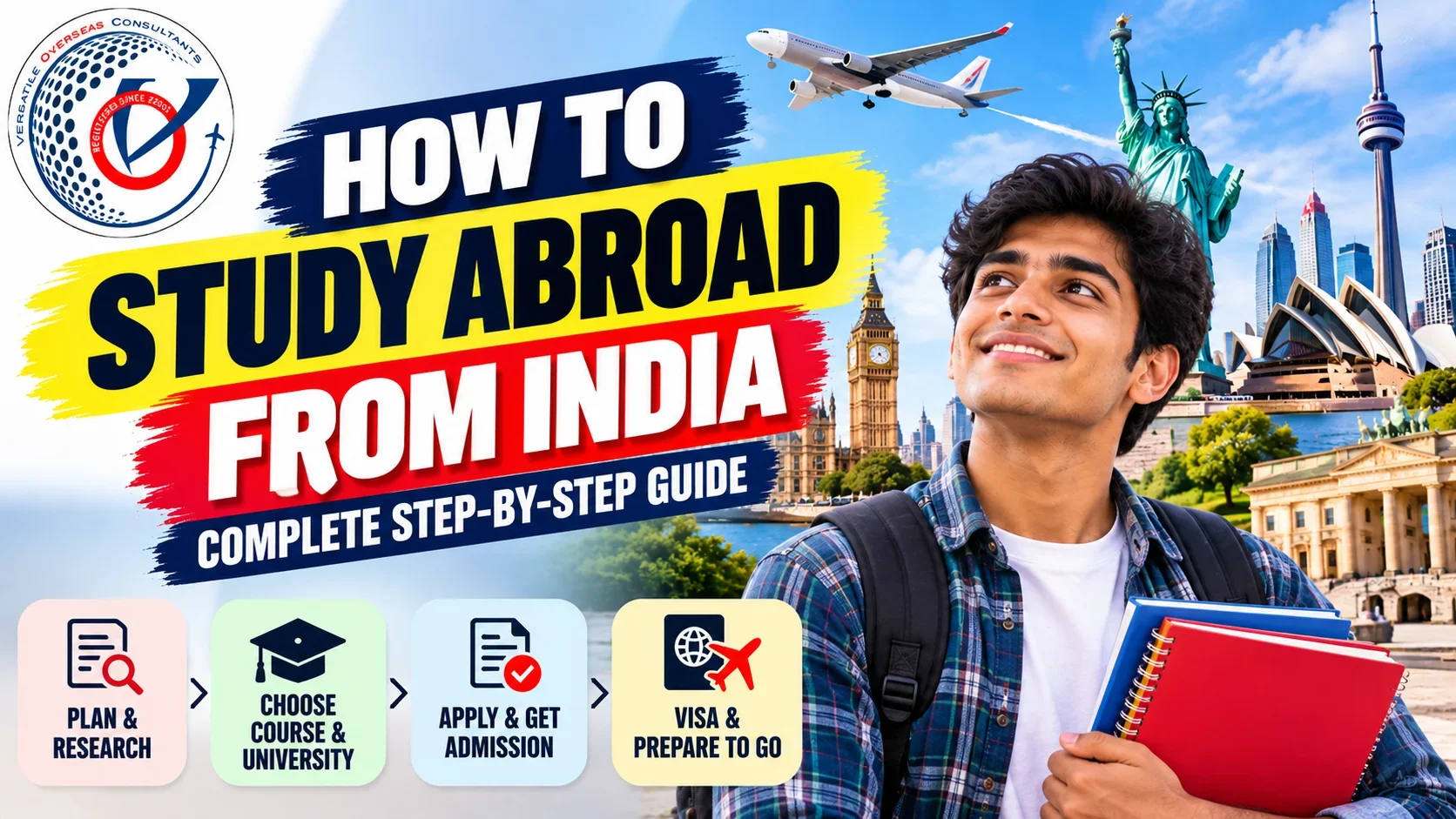
How to Study Abroad from India: Complete Step-by-Step Guide
A practical step-by-step guide for Indian students covering country selection, university shortlisting, tests, applications, funding, visas and pre-departure planning.
A practical step-by-step guide for Indian students covering country selection, university shortlisting, tests, applications, funding, visas and pre-departure planning.
By Rashmi Matlani
October 2, 2026
Quick answer
To study abroad from India, first define your academic and career goal, then shortlist countries, courses and universities that fit your profile and budget. After that, check entry requirements, take any required English-language or aptitude tests, prepare documents, apply to universities and scholarships, arrange finances, accept an offer, apply for the student visa and complete pre-departure formalities.
For most students, the safest approach is to begin 12–18 months before the intended intake. Some applications can be completed faster, but early planning gives more time for tests, scholarships, financial documentation and visa processing.
Step 1: Decide what you want to study and why
Do not start with a country name. Start with the outcome you want.
Ask:
- What subject do I want to study?
- Do I need a bachelor’s, master’s, diploma or pathway programme?
- What career roles should this degree prepare me for?
- What is my total family budget?
- Am I looking for research depth, industry exposure, shorter course duration or lower tuition?
A good study-abroad plan connects your previous education, the proposed course and your career direction.
Step 2: Shortlist countries
Compare destinations on more than rankings. Evaluate:
- availability of your preferred course
- tuition fees and living expenses
- course duration
- scholarship options
- English-language requirements
- climate and lifestyle
- student support
- internship and work rules
- visa requirements
- recognition of the qualification in India and elsewhere
For example, the US offers a very broad range of institutions and programmes; the UK has many one-year master’s programmes; Germany has low or no tuition at many public universities, though exceptions apply; Australia offers a large international education ecosystem.
Step 3: Build a realistic university shortlist
Create three groups: ambitious, realistic and safer options. Admission is never guaranteed, so applying only to highly selective universities increases risk.
Check the official university page for:
- academic requirements
- accepted Indian qualifications
- prerequisite subjects
- English-language score
- work-experience requirements
- portfolio/GRE/GMAT requirements where relevant
- application deadline
- tuition and deposit
- scholarships
EducationUSA recommends beginning research 12–18 months before intended enrolment for US study.
Step 4: Check tests
Depending on the destination and university, you may need IELTS Academic, TOEFL iBT or PTE Academic. Some universities may waive an English test based on prior education, but this is institution-specific.
GRE or GMAT may be required or optional for some programmes. Never take a test merely because “everyone takes it”; verify the requirement for your chosen programme.
Step 5: Prepare your documents
Commonly required documents include:
- passport
- academic transcripts and marksheets
- degree/provisional certificate
- school certificates for undergraduate applications
- English-language test scores
- statement of purpose or essays
- letters of recommendation
- CV/resume for postgraduate programmes
- work-experience letters where applicable
- portfolio for creative programmes
- financial documents later in the process
Requirements vary by university and country.
Step 6: Write a strong application
Your application should explain fit, not merely ambition. A strong SOP connects:
past education → present interests → chosen programme → future goals.
Avoid generic claims such as “this is a world-class university.” Mention specific modules, facilities, research groups or learning opportunities relevant to your goal.
Step 7: Apply early for scholarships and funding
Scholarships may be university-funded, government-supported, subject-specific or merit-based. Some scholarship deadlines are earlier than admission deadlines.
Budget for more than tuition:
- living costs
- insurance
- visa fees
- deposits
- test fees
- travel
- books/equipment
- emergency funds
EducationUSA advises international students to evaluate finances early because costs vary significantly by institution and location.
Step 8: Compare offers before accepting
Do not automatically choose the highest-ranked university. Compare:
- total cost
- scholarship
- curriculum
- duration
- location
- class structure
- employability support
- internship possibilities
- accreditation
- student support
Calculate total cost of attendance, not tuition alone.
Step 9: Arrange education funding
Funding may include family savings, education loans, scholarships, sponsorships and other permitted sources. Visa authorities may specify which forms of financial evidence are acceptable.
Keep funds and documents transparent and traceable. Avoid last-minute unexplained deposits.
Step 10: Apply for the student visa
Visa requirements are country-specific. Use only the official immigration website for the latest checklist.
Typical requirements can include:
- offer/acceptance document
- passport
- financial evidence
- health or insurance documents
- biometrics
- academic documents
- English evidence
- medical or TB testing where applicable
Step 11: Prepare for departure
Before flying, arrange accommodation, insurance, forex, international payment access, essential medicines and copies of important documents. Attend university pre-departure sessions and understand visa conditions.
What is the ideal study-abroad timeline?
12–18 months before: research destinations and universities.
9–12 months before: tests, documents and applications.
6–9 months before: scholarships, offers and financing.
3–6 months before: accept offer, deposits and visa preparation.
1–3 months before: visa, accommodation and travel.
Final weeks: forex, packing and pre-departure preparation.
Frequently asked questions
Can I study abroad with average marks?
Yes, depending on the university and programme. Universities evaluate academic history differently, and many also consider subject relevance, work experience, projects, essays and English proficiency.
Can I study abroad without IELTS?
Sometimes. Some institutions accept alternative tests or grant waivers based on previous education. Check the exact university and visa requirements.
How many universities should I apply to?
There is no universal number. A balanced shortlist is more useful than applying randomly to many institutions.
What is the first step?
Clarify your course, career goal and budget before choosing a destination.
Study-abroad planning for Indian students in 2026
For Indian students, a complete study-abroad plan usually combines overseas education counselling, university shortlisting, study-abroad scholarships, education-loan planning, English-language tests, SOP and LOR preparation, foreign university applications and the student-visa process. Search terms such as “study abroad from India,” “overseas education for Indian students,” “masters abroad,” “study abroad scholarships,” “student visa,” “education loan for study abroad” and “study abroad consultants in India” often describe different stages of the same journey. The useful approach is to connect them into one timeline instead of treating each as a separate decision.
Students should also review post-study work rules, employability support and return on investment, but these should be checked against current government and university sources because immigration policies and work rights can change. A strong study-abroad application is therefore not only about getting admission; it is about choosing a course, university, country and funding plan that remain academically and financially sensible.
Related reading
These guides on the Versatile Overseas Consultants blog cover closely connected questions:
- How to Choose the Right Country for Studying Abroad
- How to Choose the Right University Abroad
- IELTS vs PTE vs TOEFL: Which Test Should You Take?
- How Much Does It Cost to Study Abroad from India?
How Versatile Overseas Consultants can help
Versatile Overseas Consultants is a study abroad consultancy established in 2005, with offices in Nashik and Pune. After the 30-minute call, the team can support you with study abroad counselling, admission application support and student visa guidance, depending on where you are in your plan. You can also read more about Versatile Overseas Consultants or explore universities abroad for Indian students.
Book a 30-minute Study Abroad Clarity Call
Not sure how this applies to your own profile, budget and target intake? Get your study abroad plan checked against your academic background in a one-to-one session. Book your 30-minute Study Abroad Clarity Call with Versatile Overseas Consultants and leave with a clear next step, before you apply anywhere.
Sources and further reading
← Back to all articles

Trusted study abroad guidance for ambitious students and parents planning overseas education with transparency. Established in 2005.
Contact Offices
Nashik HQ: 401, Dattatray Darshan, College Road
Pune Hub: Shop 104, 10 Biz Park, Viman Nagar
© 2026 Versatile Overseas Consultants. All Rights Reserved.