
Quick answer
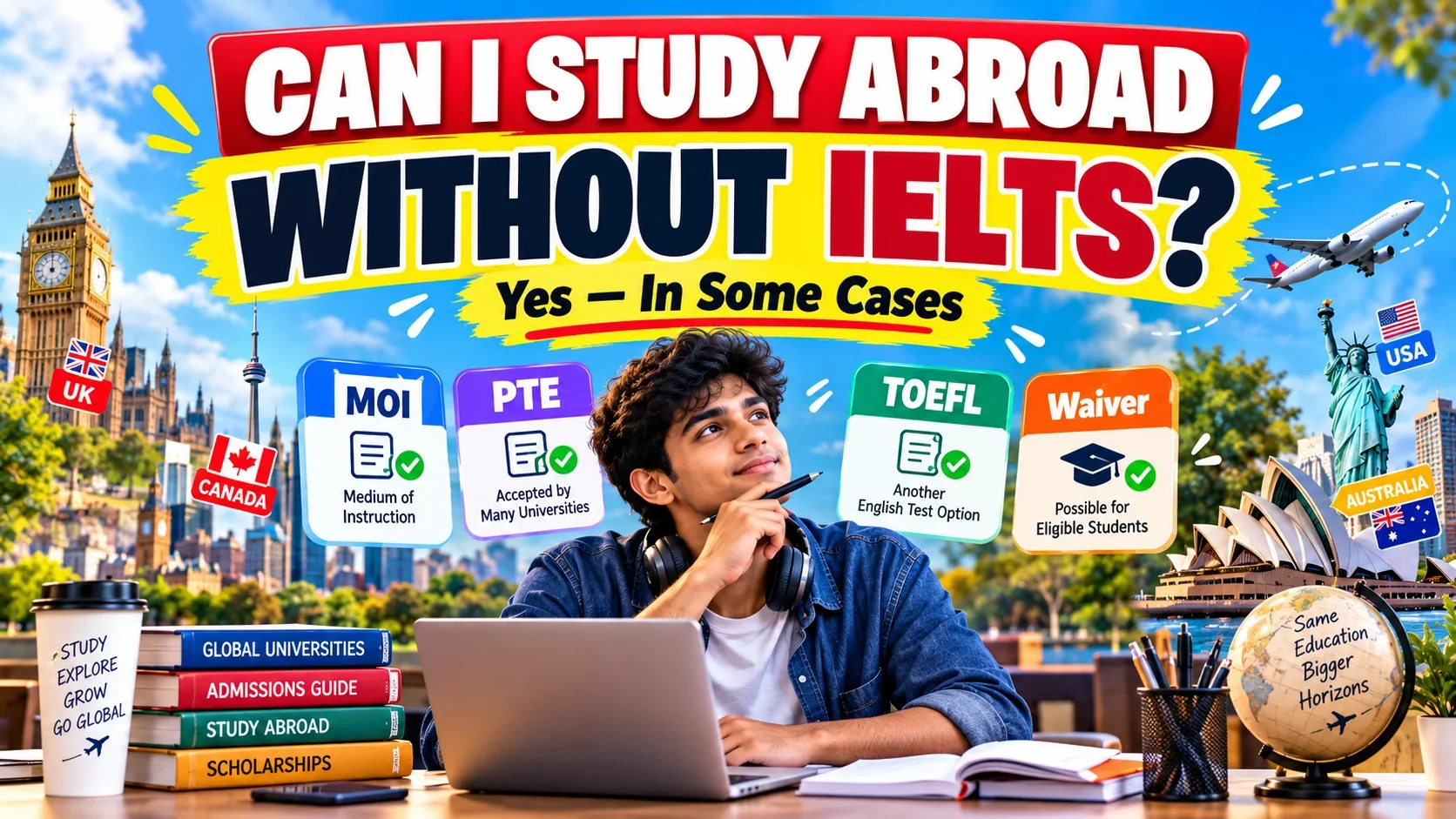
Yes, in some cases. Studying abroad without taking IELTS may be possible if the university accepts another English-language test, grants an English-test waiver or accepts other approved evidence of proficiency.
However, “without IELTS” does not always mean “without any English requirement.”
You must check two separate things:
- university admission requirements
- student-visa or immigration requirements
To compare the alternative exams, read IELTS vs PTE vs TOEFL.
Alternative English tests
Common alternatives include:
TOEFL iBT
ETS states that TOEFL iBT scores are accepted by more than 13,000 institutions across 160+ countries. Individual course requirements still vary.
PTE Academic
Pearson states that PTE Academic is accepted for study applications by more than 4,000 institutions worldwide and is recognised in major destinations. Students should still confirm acceptance for the exact programme.
Other evidence
Some institutions may accept:
- previous education taught in English
- institution-specific English assessment
- other recognised tests
- successful completion of a pathway or language programme
The policy can vary even between departments at the same university.
What is an IELTS waiver?
An IELTS waiver means the university decides that you do not need to submit IELTS based on its own policy.
Possible grounds may include:
- previous education in English
- specific school-board qualifications
- prior degree from an accepted institution
- another approved English test
Do not assume you qualify merely because your college issued a “medium of instruction” letter.
Admission waiver vs visa requirement
This distinction is critical.
A university may be satisfied with your English ability for admission, but the destination’s immigration rules may impose separate requirements.
Always check the official visa website before relying on an admission waiver.
Is “without IELTS” a good reason to choose a university?
No.
Choose a university because it fits your:
- course goal
- academic profile
- budget
- location
- career direction
English-test flexibility should be a secondary factor.
Who should still consider taking an English test?
Taking IELTS, TOEFL or PTE can be useful if:
- you are applying to several countries
- different universities have different waiver policies
- a scholarship requires a score
- you want a wider university shortlist
- the visa process requires specific evidence
How to check if your university accepts a waiver
Use the official programme page and search for:
“English language requirements”
“international entry requirements”
“English proficiency waiver”
“accepted tests”
If unclear, email admissions and ask for written confirmation.
Frequently asked questions
Can I study in the UK without IELTS?
Possibly for some university admissions, depending on the institution and how it assesses English. Visa-related English requirements must also be checked under the applicable route.
Can I study in Australia without IELTS?
A university may accept other tests or evidence. The student visa has its own rules, so verify current requirements on the Department of Home Affairs site.
Is PTE accepted instead of IELTS?
Many institutions accept PTE Academic. Pearson reports 4,000+ accepting institutions globally. Verify the exact course.
Is TOEFL accepted widely?
Yes. ETS reports TOEFL iBT acceptance at 13,000+ institutions across 160+ countries.
Study abroad without IELTS: understand what the search really means
“Study abroad without IELTS,” “universities without IELTS,” “IELTS waiver for Indian students,” “PTE accepted universities,” “TOEFL accepted universities” and “medium of instruction certificate” are closely related search topics. The critical point is that avoiding IELTS does not necessarily mean avoiding proof of English proficiency.
A university may accept PTE Academic, TOEFL iBT, another recognised test or an institutional waiver. The visa authority may have separate English-language requirements. Students should therefore verify both university admission and student-visa rules before depending on an IELTS waiver. This is especially important when applying to several countries, because one accepted English test can often keep more options open.
Related reading
These guides on the Versatile Overseas Consultants blog cover closely connected questions:
- IELTS vs PTE vs TOEFL: Which Test Should You Take?
- How to Study Abroad from India: Complete Step-by-Step Guide
- What CGPA Is Required to Study Abroad?
- Can I Study Abroad with Low Marks or a Low CGPA?
How Versatile Overseas Consultants can help
Versatile Overseas Consultants is a study abroad consultancy established in 2005, with offices in Nashik and Pune. After the 30-minute call, the team can support you with admission application support, student visa guidance and study abroad counselling, depending on where you are in your plan. You can also read more about Versatile Overseas Consultants or explore universities abroad for Indian students.
Book a 30-minute call
Not sure how this applies to your own profile, budget and target intake? Get your English-test plan checked against your academic background in a one-to-one session. Book a 30-minute call with Versatile Overseas Consultants and leave with a clear next step, before you apply anywhere.