Last verified: 2 October 2026
Quick answer
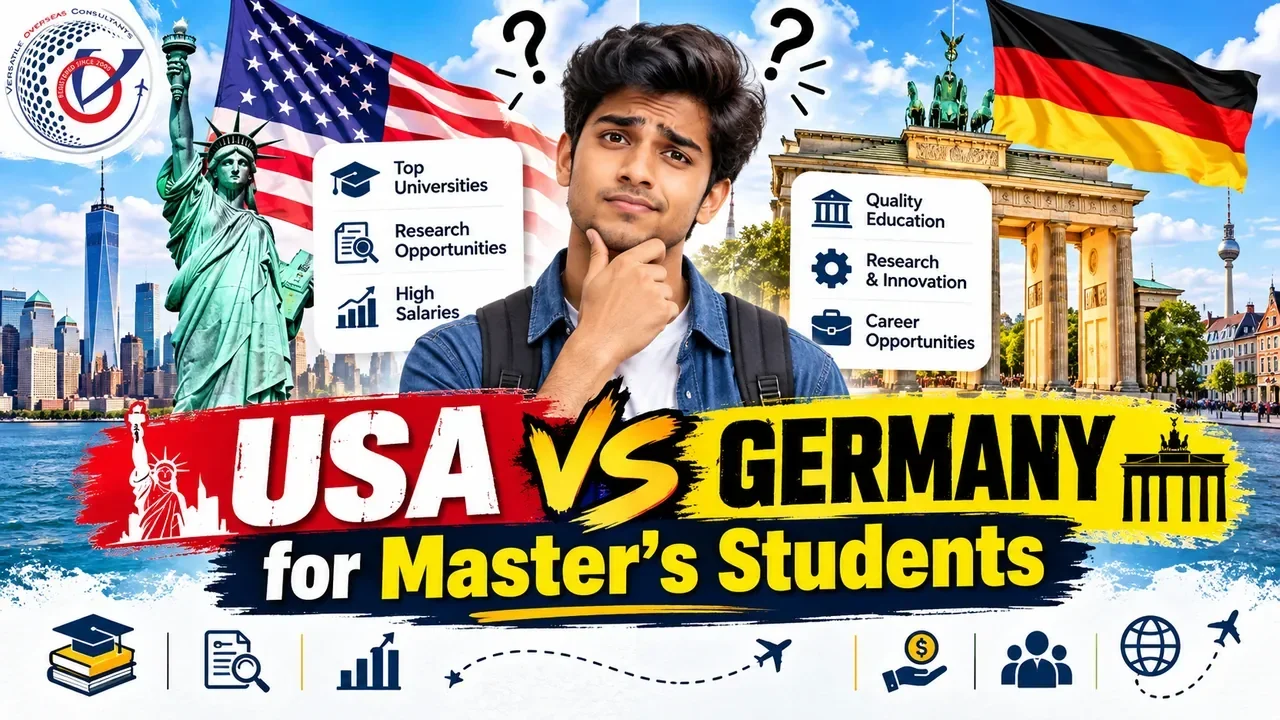
Germany is usually more attractive on tuition cost, particularly at state universities. The USA offers a much larger university ecosystem, more programme flexibility and extensive research and assistantship opportunities.
For Indian master’s applicants, the choice is often: Germany for cost efficiency and engineering depth. USA for research breadth, flexibility and a large technology ecosystem.
If computing is your intended field, also compare the best countries for computer science students.
For a closer look at computing pathways, explore our computing study options abroad.
USA vs Germany: quick comparison
Factor | USA | Germany |
|---|---|---|
Tuition | Varies widely by institution; no single official national range | Most state institutions generally have no tuition for bachelor’s and most master’s; exceptions apply |
Living costs | Vary widely by city/state | About €900–€1,200/month |
Typical master’s duration | Often 1–2 years | Commonly 2 years |
Major intakes | Fall main; Spring common | Winter semester main; summer semester for some programmes |
English/language | English proficiency normally required for non-native speakers; university sets tests/scores | Many English-taught master’s programmes; some require German; programme-specific language criteria |
Work during study | F-1 employment restricted; on-campus work and authorised practical training rules apply | Up to 140 full days or 280 half-days/year, or up to 20 hours/week under applicable rules |
Post-study | OPT generally up to 12 months; eligible STEM graduates may qualify for 24-month STEM extension | Up to 18 months after graduation to seek skilled employment |
Cost: Germany usually wins
DAAD states that most state-funded German higher-education institutions generally do not charge tuition for bachelor’s and most master’s programmes.
Students still pay:
- semester contribution
- living costs
- insurance
- visa-related financial proof
By contrast, EducationUSA emphasises that US costs vary by institution and students must compare tuition, fees and living expenses separately.
Research and programme flexibility
The USA has a major advantage in scale.
Students can choose:
- thesis master’s
- professional master’s
- interdisciplinary programmes
- research assistantships
- teaching assistantships
- flexible elective structures
Germany has strong research universities and technical institutions, particularly in engineering, manufacturing, automotive, energy and applied sciences.
Funding
US graduate funding can materially change the economics of a degree.
Assistantships may provide:
- tuition remission
- stipend
- research experience
But they are competitive and should not be assumed.
Germany’s financial advantage is often structural: lower tuition at many public institutions.
Which is better for engineering?
Germany can be particularly compelling for:
- mechanical
- automotive
- manufacturing
- mechatronics
- electrical engineering
The USA can be particularly compelling for:
- computer engineering
- AI
- robotics
- aerospace
- biomedical engineering
- advanced research fields
There is substantial overlap. Compare departments and laboratories, not country stereotypes.
Language
US programmes are taught in English.
Germany offers a growing range of English-taught master’s programmes, but learning German can help with:
- internships
- part-time work
- networking
- employment after graduation
Work while studying
US F-1 students face specific restrictions. Employment must fit authorised categories.
Germany provides a clearer annual work allowance for third-country students: up to 140 full days or 280 half-days, with an alternative 20-hour weekly framework during lecture periods.
Post-study
The USA provides up to 12 months of OPT for eligible F-1 graduates, with an additional 24-month STEM OPT extension for qualifying degrees and employers.
Germany provides up to 18 months after graduation to seek skilled employment.
The US STEM route can therefore be longer, while Germany provides a general job-search period after German study.
Which suits an Indian student better?
Choose USA if:
- you value research breadth
- you want academic flexibility
- assistantship possibilities matter
- you are targeting US technology/research ecosystems
Choose Germany if:
- tuition budget is critical
- engineering/industrial fields are central
- you can invest in German language skills
- you prefer a lower-debt route
Frequently asked questions
Is Germany cheaper than the USA for a master’s?
Usually, especially at public universities with no general tuition. But compare full living costs and programme duration.
Is the USA better for research?
The US has exceptional scale and breadth, but Germany also has strong research universities and institutes.
Do I need German for a German master’s?
Not for every English-taught programme, but German can significantly help employability and daily life.
Which has better post-study work?
It depends on the field. Eligible US STEM graduates may receive up to 36 months of OPT in total. Germany offers up to 18 months to find skilled work.
Related reading
These guides on the Versatile Overseas Consultants blog cover closely connected questions:
- Germany vs UK for Indian Students
- Germany vs Ireland for Indian Students
- USA vs UK: Which Is Better for Indian Students?
- Best Countries for Computer Science Students
How Versatile Overseas Consultants can help
Versatile Overseas Consultants is a study abroad consultancy established in 2005, with offices in Nashik and Pune. After the 30-minute call, the team can support you with country selection support, university shortlisting and education loan assistance, depending on where you are in your plan. You can also read more about Versatile Overseas Consultants or explore universities abroad for Indian students.
Book a 30-minute call
Not sure how this applies to your own profile, budget and target intake? Get your country shortlist checked against your academic background in a one-to-one session. Book a 30-minute call with Versatile Overseas Consultants and leave with a clear next step, before you apply anywhere.