Study abroad insights
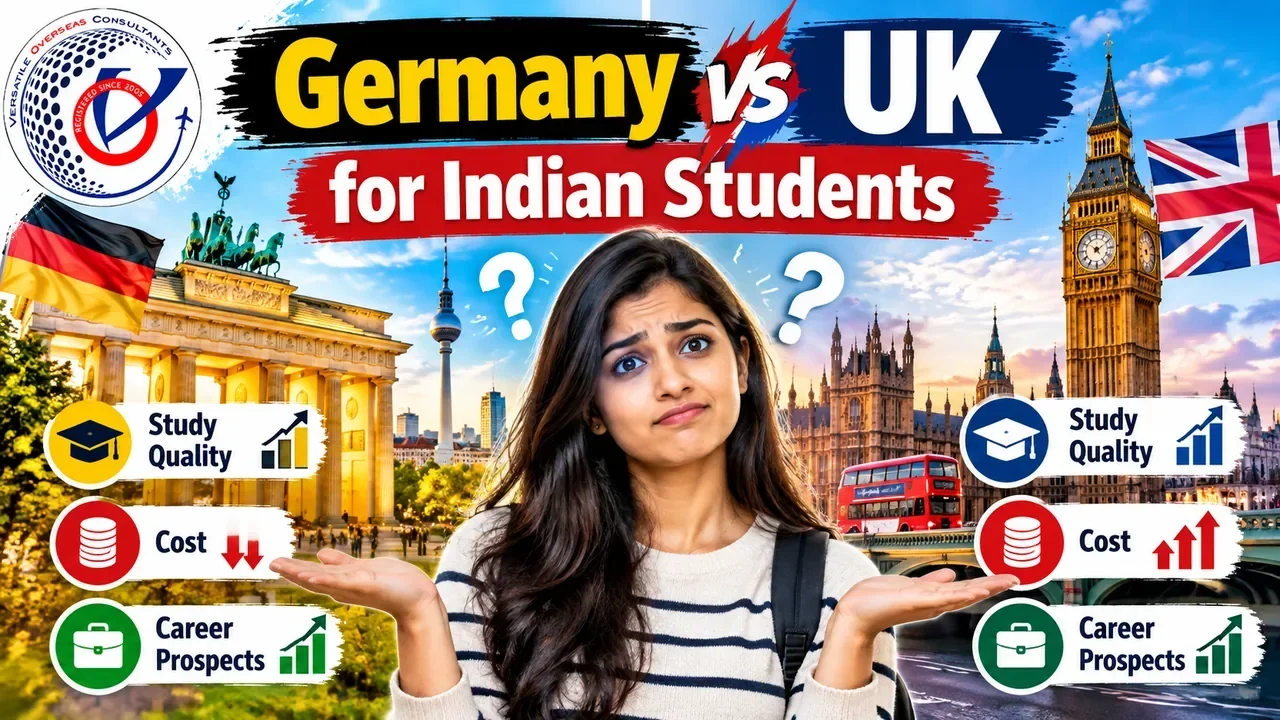
Germany vs UK for Indian Students
Germany vs UK for Indian students in 2026: compare tuition, living costs, degree duration, intakes, English requirements, student work and graduate options.
Germany vs UK for Indian students in 2026: compare tuition, living costs, degree duration, intakes, English requirements, student work and graduate options.
By Sharayu
October 5, 2026
Last verified: 2 October 2026
Quick answer
Germany is often more attractive for students prioritising low tuition at public universities, especially in engineering and technical fields. The UK is often better for students who want a large selection of English-taught programmes and a one-year master’s.
The key trade-off is usually lower tuition in Germany versus shorter programme duration and simpler English-language study in the UK.
Germany vs UK: quick comparison
Factor | Germany | UK |
|---|---|---|
Tuition | Most state institutions generally charge no tuition for bachelor’s and most master’s; exceptions include Baden-Württemberg (€1,500/semester for many non-EU students) and some Bavarian institutions; semester contribution about €70–€430 | UG about £11,400–£38,000/year; PG about £9,000–£30,000 |
Living-cost benchmark | About €900–€1,200/month; 2026 study-visa financial proof can be €11,904 | About £1,300–£1,400/month London; £900–£1,300 elsewhere |
Typical bachelor’s duration | About 3 years | About 3 years; often 4 in Scotland |
Typical master’s duration | Commonly 2 years | Many full-time master’s programmes are 1 year |
Major intakes | Winter semester (around October) is main; summer semester (around April) available for some programmes | September/October main; January common for many programmes |
English/language | English-taught programmes set their own requirements; some courses require German. Visa guidance notes some programmes require around B2 language level | English-language requirements vary by university and visa/sponsor rules |
Work while studying | Up to 140 full days or 280 half-days/year, or up to 20 hours/week under relevant rules | Eligible degree-level students usually up to 20 hours/week in term |
Post-study | Graduates can apply for up to 18 months to seek skilled employment | Graduate route: 18 months for most eligible non-PhD applications from 1 Jan 2027; PhD 3 years |
Tuition: Germany has the clearest advantage
DAAD states that most state-funded higher-education institutions generally do not charge tuition for bachelor’s and most master’s programmes.
Important exceptions:
- Baden-Württemberg: €1,500 per semester for many non-EU students
- Bavaria: some institutions may charge non-EU tuition
- private universities
- continuing-education master’s programmes
Students also pay a semester contribution, typically around €70–€430.
The UK is much more tuition-intensive, with postgraduate tuition commonly ranging from £9,000 to £30,000.
But duration changes the calculation
A German master’s often takes two years. A UK master’s often takes one.
Therefore: Germany = lower tuition + longer living-cost period. UK = higher tuition + shorter living-cost period.
For some students, Germany still remains far cheaper overall. For others, the one-year UK route reduces the gap.
Living costs
DAAD estimates around €900–€1,200 per month in Germany depending on location.
For 2026, Germany’s official skilled-migration portal states that study-visa applicants may need to demonstrate at least €11,904 in financial resources, subject to the applicable proof route.
Study UK suggests around £900–£1,300 per month outside London and £1,300–£1,400 in London.
Engineering and STEM
Germany is especially relevant for:
- mechanical engineering
- automotive engineering
- manufacturing
- mechatronics
- electrical engineering
- renewable energy
- industrial technology
The UK also has strong engineering universities and may be more convenient for students who want a fully English academic environment.
Programme language matters. Many German master’s degrees are taught in English, but German ability can still be valuable for internships, daily life and employment.
Work while studying
Germany currently permits many third-country students to work up to 140 full days or 280 half-days per year, or up to 20 hours per week during the lecture period under the alternative calculation.
The UK permits eligible degree-level students up to 20 hours per week during term-time.
The headline limits are similar, but Germany uses additional full-day/half-day rules.
Graduate options
Germany allows graduates to obtain a residence permit for up to 18 months to look for skilled employment after completing a German degree.
The UK Graduate route will also be 18 months for most bachelor’s/master’s graduates applying from 1 January 2027, while PhD graduates retain three years.
The practical difference is not only duration. Germany’s route is tied to transitioning toward skilled employment; UK Graduate permission is an unsponsored post-study route.
Which is better for Indian students?
Germany may be the stronger fit if:
- tuition budget is critical
- your field is engineering or technical
- you are comfortable learning some German
- you can handle a two-year master’s
The UK may fit better if:
- you want a one-year master’s
- you prefer an English-only study environment
- you want more programme choice
- you want a simpler academic transition
Frequently asked questions
Is studying in Germany free?
Not universally. Most state institutions generally do not charge tuition for bachelor’s and most master’s programmes, but exceptions and semester contributions apply.
Is the UK better for a one-year master’s?
Yes, one-year taught master’s programmes are common in the UK.
Do I need German to study in Germany?
Not always. Many international programmes are taught in English, but some programmes require German, and German can materially help daily life and employment.
Which is better for engineering?
Germany has a strong cost-and-industry proposition; the UK offers excellent universities and more English-language convenience. Compare programme-level strengths.
Related reading
These guides on the Versatile Overseas Consultants blog cover closely connected questions:
- Germany vs Ireland for Indian Students
- USA vs Germany for Master's Students
- USA vs UK: Which Is Better for Indian Students?
- UK vs Ireland for Indian Students
How Versatile Overseas Consultants can help
Versatile Overseas Consultants is a study abroad consultancy established in 2005, with offices in Nashik and Pune. After the 30-minute call, the team can support you with country selection support, university shortlisting and student visa guidance, depending on where you are in your plan. You can also read more about Versatile Overseas Consultants or explore universities abroad for Indian students.
Book a 30-minute Study Abroad Clarity Call
Not sure how this applies to your own profile, budget and target intake? Get your country shortlist checked against your academic background in a one-to-one session. Book your 30-minute Study Abroad Clarity Call with Versatile Overseas Consultants and leave with a clear next step, before you apply anywhere.
Official sources
← Back to all articles

Trusted study abroad guidance for ambitious students and parents planning overseas education with transparency. Established in 2005.
Contact Offices
Nashik HQ: 401, Dattatray Darshan, College Road
Pune Hub: Shop 104, 10 Biz Park, Viman Nagar
© 2026 Versatile Overseas Consultants. All Rights Reserved.